
On Monday, August 4, 2025, NASA moved to fast-track a lunar nuclear reactor: Transportation Secretary Sean Duffy, who is also the interim NASA administrator, directed the agency to seek industry proposals for a 100-kilowatt fission reactor to launch to the Moon by 2030. This is the first major NASA initiative under the Trump administration’s new leadership and comes amid budget cuts. A senior NASA official noted that this push is “about winning the second space race”.
Indeed, the United States is not alone. China and Russia have announced their own lunar base plans: China aims to land astronauts on the Moon by 2030 (with its Chang’e 8 mission) and to build a permanent research station (the International Lunar Research Station, ILRS) with Russia by the mid-2030s. A recently signed China–Russia cooperation agreement explicitly calls for a joint nuclear power plant on the Moon to supply the ILRS, a crucial element to sustain a human presence there.
In short, it seems that a new lunar power race has begun: small reactors are now front and center as both superpowers jockey to power their Moon bases. What does this mean for…?
What’s Happening? US Plans: A 100‑kW Reactor by 2030
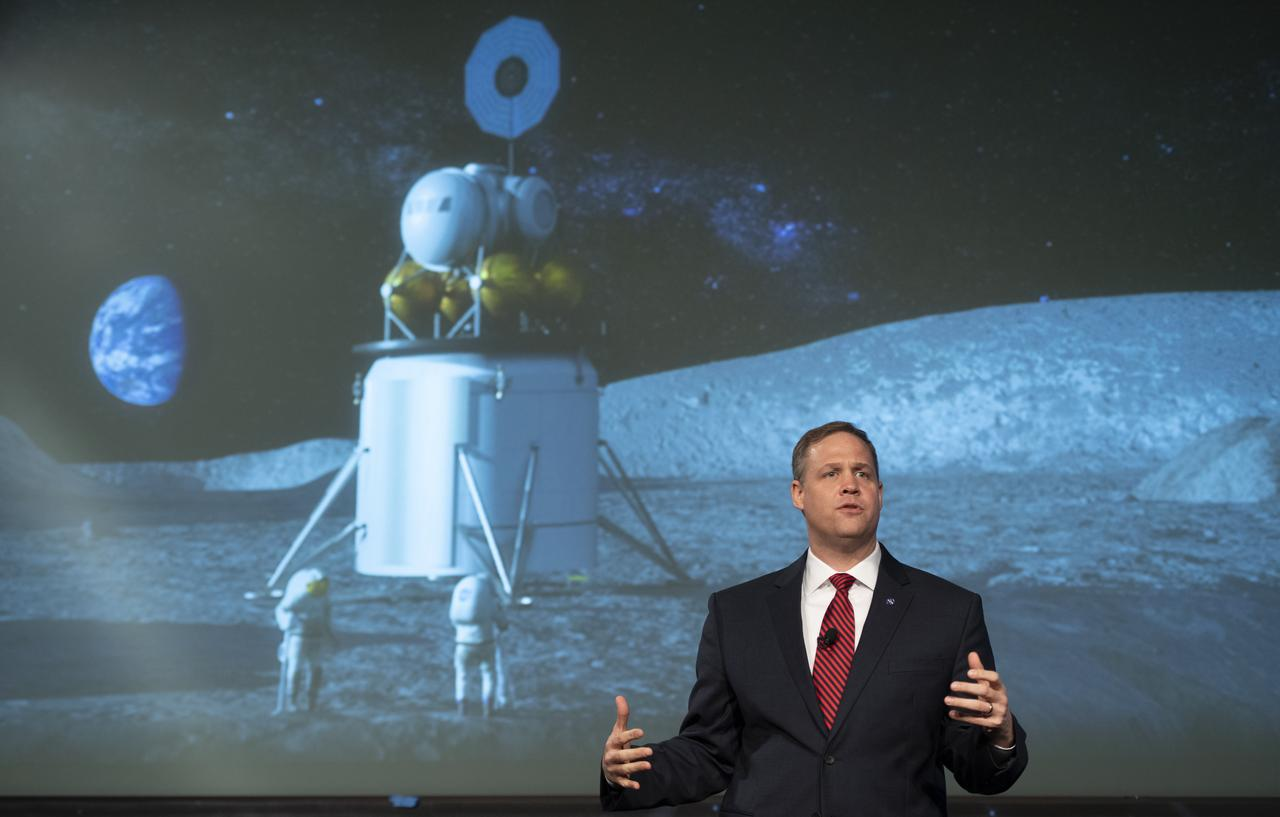 NASA Administrator Jim Bridenstine speaks at the opening of an industry forum on the agency’s lunar exploration plans
The Duffy directive makes NASA explicitly responsible for developing a lunar reactor. The memo orders NASA to solicit industry proposals for a 100 kW reactor launch by 2030. (For context, NASA’s own Fission Surface Power project had earlier targeted a 40 kW system in the early 2030s.) The new goal is significantly more ambitious: more than doubling the output of past studies.
Duffy emphasized that such “high power energy generation on [the] Moon and Mars” is needed to support a future lunar economy and national security. Key points of the US plan include:
- Timeline: 100 kW reactor on the Moon by ~2030. Industry proposals are due within 60 days of the directive.
- Scale: 100 kW is far smaller than terrestrial reactors (multimegawatt) but enough to support a modest Moon base of habitats and equipment. (NASA notes 40 kW can power ~30 households for a decade.)
- Context: This project complements the Artemis program’s goals to establish a sustained lunar presence. It also ties into related initiatives (e.g., replacing the International Space Station) intended to bolster U.S. leadership in space.
Why now?
This push for a lunar nuclear reactor comes amid shifting priorities at NASA under new leadership. Duffy, a former congressman and interim NASA chief, may view the reactor as a high-visibility “win” for Artemis. As one NASA official told reporters, the reactor effort is “the first major agency effort” by Duffy and part of an accelerated lunar agenda.
The White House has proposed cutting many science missions to bolster human spaceflight. In July, President Donald Trump appointed former congressman Sean Duffy as acting NASA administrator after unexpectedly pulling the nomination of billionaire Jared Isaacman, reportedly following tensions involving Isaacman’s associate, Elon Musk.
Shortly after stepping in, Duffy issued directives aimed at fast-tracking both the development of a Moon-based nuclear reactor and the replacement of the aging International Space Station – two moves that could significantly accelerate U.S. ambitions for crewed missions to the Moon and eventually Mars, especially as China pursues similar goals. These actions align closely with the Trump administration’s broader space policy, which emphasizes human spaceflight over scientific exploration.
The proposed federal budget for 2026 reflects this shift, recommending steep cuts to science programs (nearly 50% in some areas!) while increasing funding for crewed missions. This move is widely seen as a strategic response to rising global competition. NASA’s briefing documents stress competition with China: whoever plants a reactor first could claim lunar “keep-out zones” that others would be forced to navigate around, which might disadvantage the other side.
China and Russia: The ILRS and Lunar Nuclear Power

China and Russia have made no secret of their intent to build a lunar base with nuclear power. In April 2025, Chinese officials presented slides showing the planned ILRS complex, including power infrastructure. China’s lunar program envisions landing astronauts by 2030 and building habitats near the Moon’s south pole. In particular, China’s Chang’e‑8 mission (slated for 2028) is intended to scout ice-rich craters and help lay the groundwork for a station there.
Russia’s space agency Roscosmos has also been clear: in 2024, it announced a joint project with China to deliver a nuclear reactor to the Moon’s surface by 2035. Roscosmos calls this reactor “an important contribution” to the ILRS effort. The official timeline (from Roscosmos presentations and the China cooperation memo) targets mid-2030s operation. Together, China and Russia now count 13–17 countries signing on to the ILRS.
The rationale is partly geopolitical: as a Chinese designer said in 2025, if NASA and ESA have Artemis, China and Russia have ILRS, each aiming for long-term bases. All in all, the global picture is clear: two lunar camps are emerging. The U.S. (with some international partners) under Artemis, and China–Russia via ILRS. Both have prioritized robust power on the Moon.
The U.S. is focusing on a relatively small reactor now to jump-start its program, while China and Russia plan a larger-scale “power plant” to serve a permanently crewed station decades from now. All sides acknowledge that the first to install nuclear power on the Moon could claim a strategic advantage.
Why Nuclear Power on the Moon?
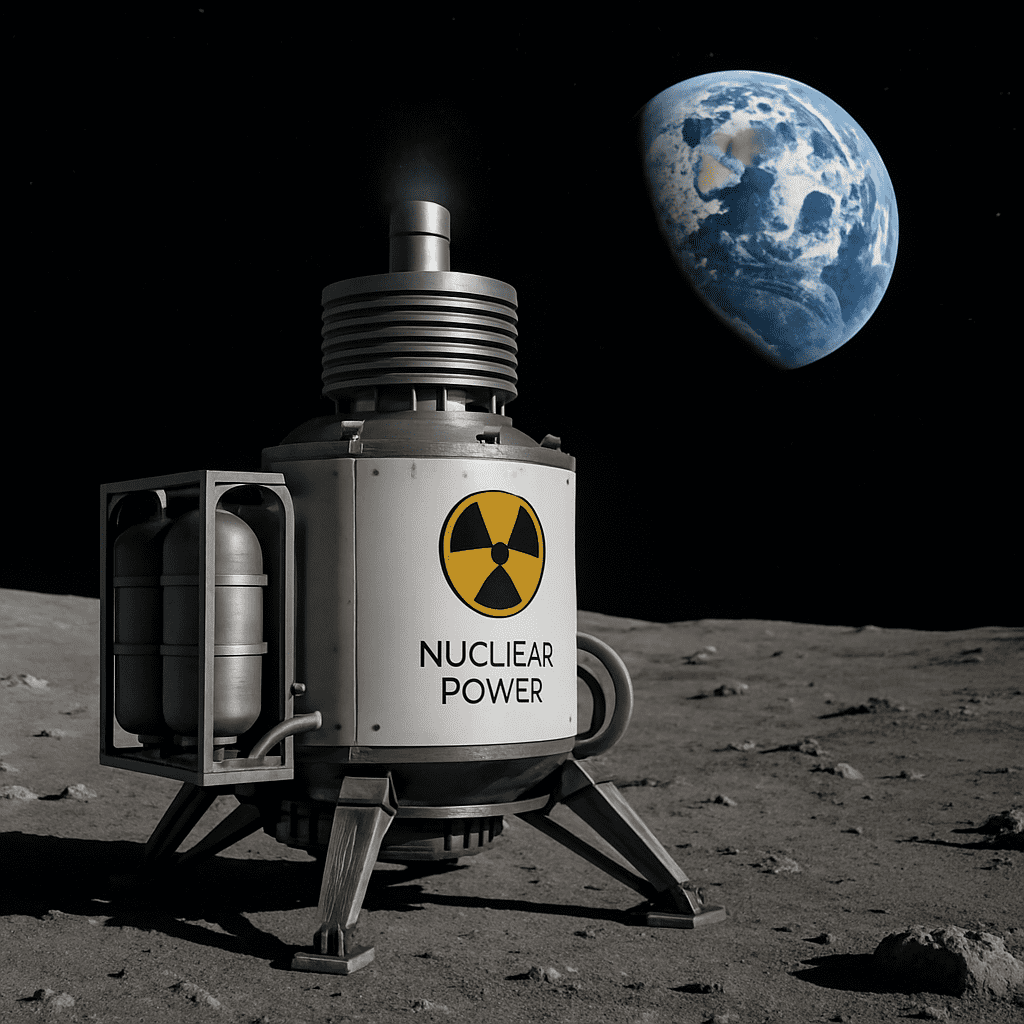 Conceptual illustration of a small nuclear fission reactor for powering a lunar outpost.
NASA engineers stress that lunar conditions make nuclear power especially attractive, as a reactor can “provide abundant and continuous power regardless of environmental conditions”– day or 14.5-day night. The lunar night is long (about two weeks of darkness) and the Sun’s angles at the poles are very low, so solar panels can produce little or no energy for long periods.
NASA’s Fission Surface Power team explains the system must run “regardless of … available sunlight”. In practice, solar missions can fail. For example, NASA’s recent PRIME-1 lander (carrying an ice-drill experiment) was lost after just 10 hours on the Moon because it got stuck on its side and could not recharge its solar cells during the long lunar night. By contrast, even a compact reactor can keep running through darkness, safely inside a habitat or cooled by radiators, largely unaffected by dust or tilt.
Basically, nuclear power offers lunar bases a steady, high-density energy source. Among the key advantages are:
- Continuous, 24/7 power: Fission reactors can run regardless of sunlight. They can be placed to operate through the 14.5 Earth-day lunar night, something solar arrays cannot do without massive battery backups.
- Compact, high-density output: Modern reactor designs deliver tens of kilowatts from a system weighing only a few tons, powering habitats, rovers, and experiments continuously. (For scale: 40 kW can supply ~30 homes on Earth.)
- Environmental resilience: Solar panels degrade from lunar dust and shadowing. A small tilt or dust cover can shut them off completely. Nuclear systems, by contrast, operate sealed and insulated; a NASA engineer noted that having a power source “independent of the Sun” is “an enabling option” for long-term Moon missions.
- Ice-Crater Compatibility: Nuclear reactors can be sited in permanently shadowed craters (rich in water ice) and run extraction equipment there, even when sunlight never reaches the ground.
These factors could explain why NASA and others have invested in space fission R&D for years. NASA’s Kilopower and Fission Surface Power efforts demonstrated subscale reactors on Earth, and the new directives aim to turn that into an actual lunar demo.
Implications for Space Mining and In-Situ Resources
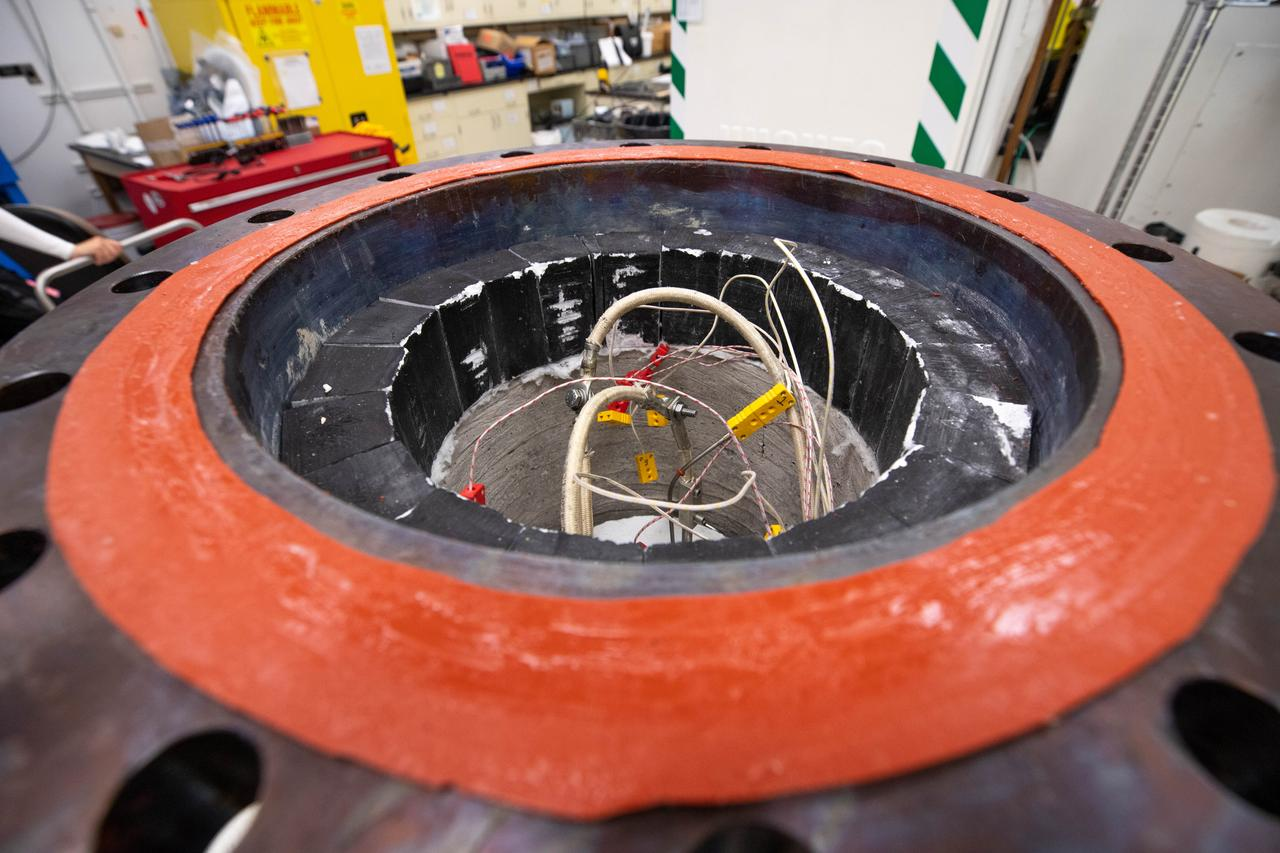 A reactor tested under NASA’s GaLORE project seekin to develop technology to extract oxygen and metals from the regolith on the Moon’s surface.
Lunar nuclear reactors tie directly into the emerging space mining ecosystem, even if they alone won’t power a Moon-scale mining operation. A 100 kW reactor isn’t enough to run a multi-thousand-ton excavation, but it is enough to enable crucial resource experiments and industry demonstrations. For example, imagine drilling into a polar ice deposit: melting ice and electrolyzing it into water and oxygen requires steady heat/electricity.
A reactor of this size could operate heaters or drills continuously on an ice pit. NASA’s early prototype drill (PRIME-1) was only powered by batteries and solar, and it proved how difficult solar can be – a nuclear generator would remove that uncertainty. NASA itself views in-situ resource utilization (ISRU) as critical for the future, citing that “Generating products for life support, propellants, construction, and energy from local materials will become increasingly important” as we return to the Moon.
Even small reactors can accelerate ISRU R&D. For instance, NASA’s recent Aqua Factorem study proposed a novel, ultra-efficient way to harvest lunar ice. Instead of baking regolith at ~800 kW to vaporize water, Aqua Factorem suggests mechanically separating tiny ice grains with only ~0.1 kW of power. In other words, a clever process could reduce an 800 kW energy task to under 100 watts!
That means a 100 kW reactor could easily supply dozens of such extraction units simultaneously. In the same study, scientists note that about 1% of lunar soil is free metal (iron, magnesium, etc.) embedded in grains. A modest power source could run the sorting equipment to capture this metal for construction or manufacturing. While these numbers (0.1–100 kW) are well within what a small reactor can provide, they underscore that smart engineering will be key.
Extracting water or oxygen on the Moon does require significant power, but not necessarily megawatts: the combination of nuclear energy and efficient techniques could bootstrap the lunar “mining” industry. In the short term, a 100 kW reactor might support demonstration operations – melting ice for a handful of astronauts, running rovers and instruments, or powering a chemical processor converting ice into rocket fuel and life-support gas. These tasks lay the foundation for a larger space mining future and long-term exploration.
By providing explorers with a reliable, high-density power source, lunar reactors will significantly enhance the productivity and dependability of ISRU systems. Over time, lessons learned from these early reactors and small mines will inform bigger projects – eventually scaling to power larger colonies or automated mining stations. In that sense, even small fission reactors are a stepping stone toward a true space-mining economy.
They shift reliance off supply rockets and onto the Moon’s own resources (water, regolith, etc.), helping humanity make the Moon a sustainable outpost.
Small Reactor, Giant Leap

The push for nuclear power on the Moon reflects how serious the new space race has become. With the U.S., China, and Russia all committing to lunar bases, dependable energy is at a premium. The U.S. effort – accelerated by Sean Duffy’s directive – will force NASA and industry to rapidly mature small-reactor technology. Meanwhile, China and Russia are treating a reactor as an essential part of their long-term lunar station.
For space-mining advocates, this is welcome news: every watt of reliable power on the Moon is fuel for excavation, processing, and science. Nuclear reactors on the Moon will primarily serve as anchors for bases and resource demos in the coming decade. They may be too small to run giant mining machines, but they will enable the first water ice harvests, oxygen plants, and regolith processing units that pave the way for larger projects.
As nuclear power plants flick on at the lunar south pole, the real prize could be turning frozen ice and rock into water, fuel, and metal – the raw materials of a thriving space-mining future.
What Happens Next?
All eyes are now on Acting NASA Administrator Sean Duffy, who is expected to formally unveil the agency’s next steps for the fast-tracked lunar nuclear reactor initiative this week (August 2025). His announcement could provide more details on the scope, timeline, and partnerships involved, and potentially set the tone for how aggressively the U.S. intends to pursue its lunar ambitions.
As China and Russia continue advancing their own plans, the geopolitical and technological stakes couldn’t be higher. For now, all we can do is watch closely as this high-stakes space power race unfolds. Here at Space Mining, we’ll be tracking every move, from contract awards and launch plans to breakthroughs in in-situ resource utilization, bringing you timely updates, expert insights, and deeper analysis. Stay tuned, as this is just the beginning.