
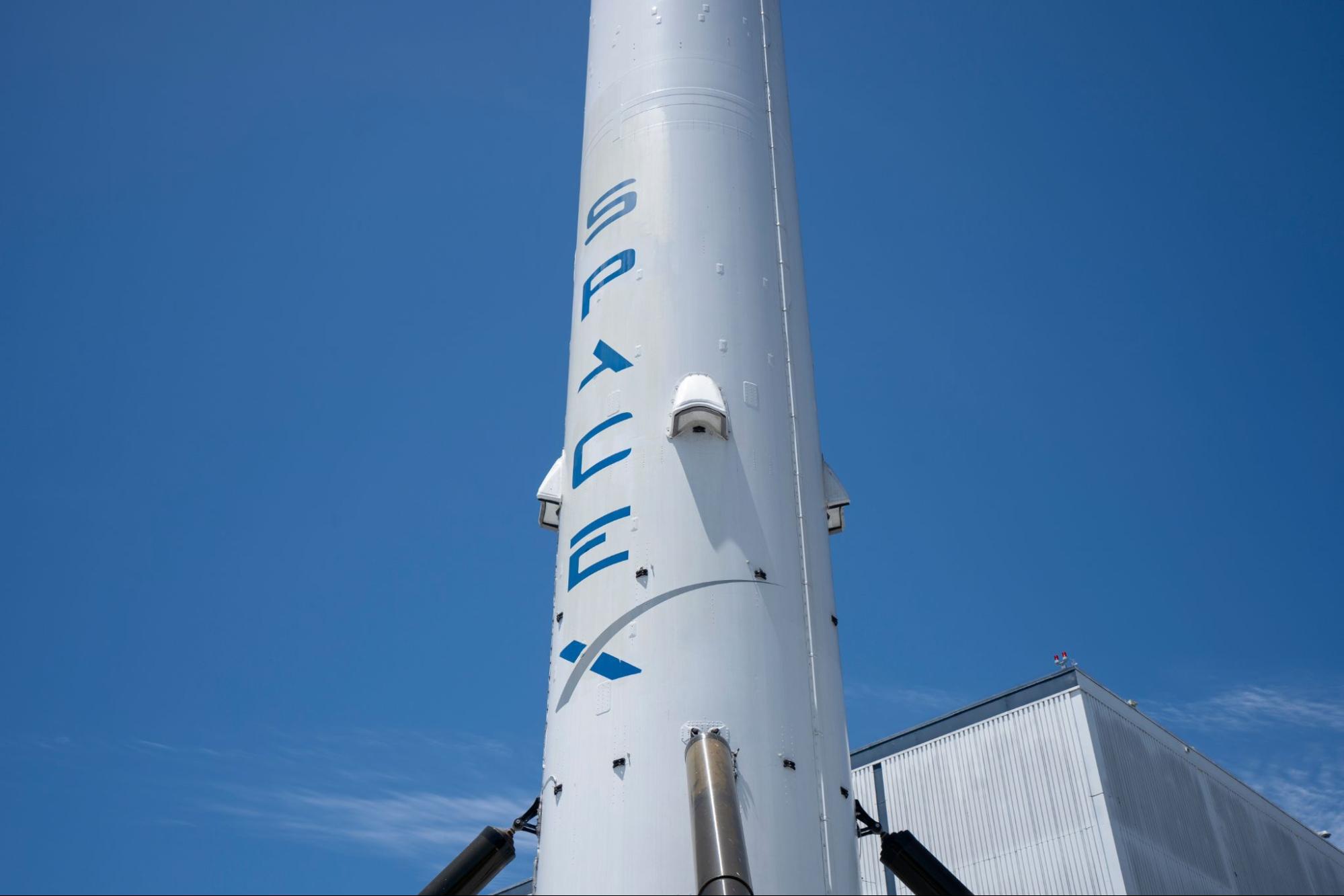
Weeks after a hard lunar landing made headlines, Intuitive Machines is already charting its next step. On April 8, the Houston-based space company announced it has tapped SpaceX to launch its fourth Moon lander – part of the IM-4 mission – in 2027. The rocket of choice? A Falcon 9, carrying not just the Company’s Nova-C class lunar lander, but also two lunar data relay satellites meant to boost NASA’s growing Near Space Network Services.
That announcement arrived on the heels of IM-2’s dramatic ending, when the Athena lander tipped on its side during descent near the lunar South Pole. Despite setbacks, the company isn’t backing down. If anything, it’s doubling down on its long-term ambitions to play a central role in Moon-bound infrastructure.
“Lunar surface delivery and data relay satellites are central to our strategy to commercialize the Moon,” said CEO Steve Altemus. “We’re building a service that can support future exploration and business alike.”
A Communications Backbone for the Moon

The IM-4 surface delivery mission does more than land hardware. It adds nodes to a future network – a lunar data relay constellation that will help robotic and crewed missions stay connected.
The two additional satellites hitching a ride with IM-4 will join one expected to launch with IM-3 in 2026. Together, they’re meant to enable continuous, pay-by-the-minute contract for communication coverage between Earth and the Moon, especially in areas with poor line-of-sight like the South Pole.
In a remote place where sunlight and visibility are fleeting, reliable navigation services and data links could be game-changers. Intuitive Machines is betting that this kind of infrastructure will become a staple of human exploration, supporting everything from resource mapping to lunar base logistics.
Big Science in Small Packages
The lander will also carry six initiative payloads selected by NASA, including a standout: a European Space Agency-led drill suite called PROSPECT. Built to dig up lunar soil and sniff for water ice or volatile compounds, PROSPECT’s results could shape future plans to extract and use Moon resources – what space experts call ISRU (in-situ resource utilization).
Other payloads aboard IM-4 include biological experiments, thermal mapping instruments, and magnetometers – each aimed at unlocking a better understanding of lunar terrain and hazards.
All of it falls under NASA’s Commercial Lunar Payload Services (CLPS) initiative, which outsources cargo delivery to the Moon to private firms like Intuitive Machines. If successful, the IM-4 mission would mark another milestone in NASA’s push to buy rather than build its way to the Moon.
Learning Curve from Actual Outcomes
Let’s be real: Intuitive Machines’ last two missions didn’t end with flawless touchdowns. Both IM-1 and IM-2 made it to the Moon, but tipped over while landing. The good news? Key hardware survived, and valuable lunar data was still collected.
Now, with IM-4 and SpaceX as partners, the company’s betting that tweaks to descent engines, terrain sensors, and solar charging systems will help the lander stick to its landing. There’s no plan to survive the frigid lunar night, but everything’s being built for efficiency during that 14-Earth-day sunlit window.
The hardware, software, and overall confidence have all grown – not from theory, but from actual outcomes.
Under the Hood: How Nova-C Keeps Evolving
The Nova-C lunar lander itself is an evolving platform. Originally designed as a lightweight, modular solution for CLPS missions, it has been undergoing refinements after every flight. It runs on a methalox engine – using liquid methane and liquid oxygen – which gives it clean combustion and throttling capability ideal for precise lunar descent.
Onboard, the lander carries multiple payload accommodation decks, an avionics suite powered by radiation-hardened computers, and solar arrays designed to operate throughout the lunar day. Each new iteration has seen improved descent control, data handling, and thermal resilience. Intuitive Machines has also made changes to its software stack to address sensor noise and terrain mapping accuracy – key lessons from IM-2’s challenges with laser altimeters.
In short, IM-4’s Nova-C is shaping up to be the most robust version yet, one designed with the Moon’s unpredictable surface in mind.
A Word of Caution
As with any space venture, there’s risk. Intuitive Machines has been upfront about it, noting in its Quarterly Report on Form 10-Q that plans can shift, launches may slip, and technical hurdles remain. These Forward-Looking Statements come with warnings not to place undue reliance on projections.
Issues like accidents on launch, budget shifts, or delays related to energetic materials and permits are real possibilities. Yet, the company continues to move forward within the bounds of applicable securities laws and public transparency.
A Lunar Economy in Progress
This mission is truly about building forward. If all goes well, the IM-4 lander and its orbiting partners will help define how future companies and space agencies conduct lunar operations.
It’s a bet on more than one mission – it’s a bet on what comes next: delivery services, lunar access economics, data relays, commercial spaceflight, and the Moon as the next great platform for innovation.
The IM-4 mission shows that setbacks don’t necessarily signal failure – they signal experience. And in this field, experience is everything.
As Intuitive Machines add more tools to the Moon’s orbit and surface, it’s carving out a place in the new frontier, and one thing’s for sure: this company is putting its vision – one launch at a time – into practice.
And who knows? In a few years, when astronauts are walking near the lunar South Pole, it might be Intuitive Machines hardware helping them phone home.